Piume di cigno / Swan feathers
My personal Hanko
Ogni costruttore di flauti Shakuhachi che si rispetti possiede un suo Hanko, ovvero una sua firma che lo identifica.
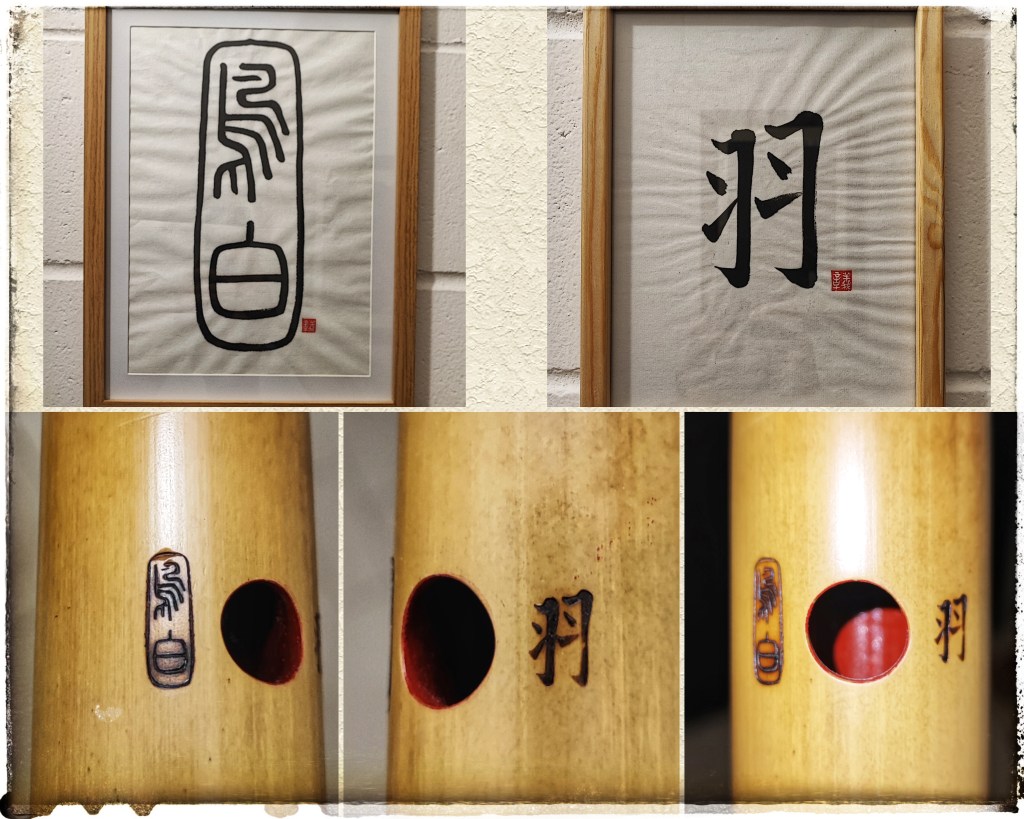
Questo Hanko può essere composto da uno o due Kanji giapponesi che danno vita ad un unica e riconoscibile firma del costruttore, che spesso viene apposta come un timbro a fuoco nella parte posteriore dello strumento vicino al quinto foro.
Questi Kanji sono di origine cinese e infatti derivano da antichi pittogrammi, secondo la leggenda infatti, sono stati importati in Giappone attorno al V secolo d.C. da Wani 王仁, uno studioso coreano che aveva legami con la Cina.
Detto questo volevo spiegarvi come ho ideato questo mio Hanko (Piume di Cigno).
Questo Hanko é composto da due Kanji, il primo rappresenta il cigno, ovvero “Grande uccello bianco” mentre il secondo significa “Piume”.
Ho scelto questi due Kanji pensando al mio cognome che è “Pinna” di origine sarda.
Molti potrebbero pensare che “Pinna” possa derivare dalla pinna di un pesce mentre la sua reale derivazione é invece “Penna”, si la penna che si usa per scrivere, infatti il mio cognome originariamente deriva dagli antichi scrivani del medioevo; ossia anche conosciuti come amanuensi, che scrivevano i documenti a mano sulle pergamene proprio con una piuma di cigno e l’inchiostro.
Ed ecco qui l’origine del mio Hanko!
Questi due timbri a fuoco mi sono stati costruiti da un Maestro di Shodo (calligrafia zen giapponese) e incisore, di nome Stefano Grossi.
Lo conobbi virtualmente durante il lookdown e facemmo subito questo meraviglioso scambio, lui mi costruì questi due timbri e io gli costruì due flauti shakuhachi che Stefano suona tutt’ora nella sua pratica “SUIZEN”.
É stato bello conoscerci, chiacchierare e scambiare opinioni sulle pratiche zen giapponesi, sui flauti shakuhachi, sullo Shodo e sulla pittura giapponese.
Quindi se qualcuno leggendo questo articolo avesse bisogno di un timbro per la calligrafia o per firmare uno shakuhachi può contattarlo a questo link!
https://www.facebook.com/stefano.grossi.16
Every self-respecting Shakuhachi flute maker has his own Hanko, or his signature that identifies him.
This Hanko can be composed of one or two Japanese Kanji which give life to a unique and recognizable signature of the maker, which is often affixed as a fire stamp on the back of the instrument near the fifth hole.
These Kanji are of Chinese origin and in fact derive from ancient pictograms, according to legend in fact, they were imported into Japan around the fifth century AD. by Wani 王仁, a Korean scholar who had ties to China.
Having said that, I wanted to explain to you how I created my Hanko (Swan Feathers).
This Hanko is composed of two Kanji, the first represents the swan, or “Big white bird” while the second means “Feathers”.
I chose these two Kanji thinking about my surname which is “Pinna” of Sardinian origin.
Many might think that “Pinna” could derive from the fin of a fish while its real derivation is instead “Penna”, yes the pen that is used to write, in fact my surname originally derives from the ancient scribes of the Middle Ages; that is, also known as scribes, who wrote the documents by hand on the parchments with a swan feather and ink.
And here is the origin of my Hanko!
These two fire stamps were made by a Master of Shodo (Japanese Zen calligraphy) and engraver, named Stefano Grossi.
I met him virtually during the lookdown and we immediately made this wonderful exchange, he built me these two stamps and I built him two shakuhachi flutes that Stefano still plays in his practice “SUIZEN”.
It was nice to get to know each other, chat and exchange views on Japanese Zen practices, shakuhachi flutes, Shodo and Japanese painting.
So if anyone reading this article needs a stamp for calligraphy or to sign a shakuhachi, they can contact them at this link!
https://www.facebook.com/stefano.grossi.16
• • •
• • •
 Jo Pinna Shakuhachi